
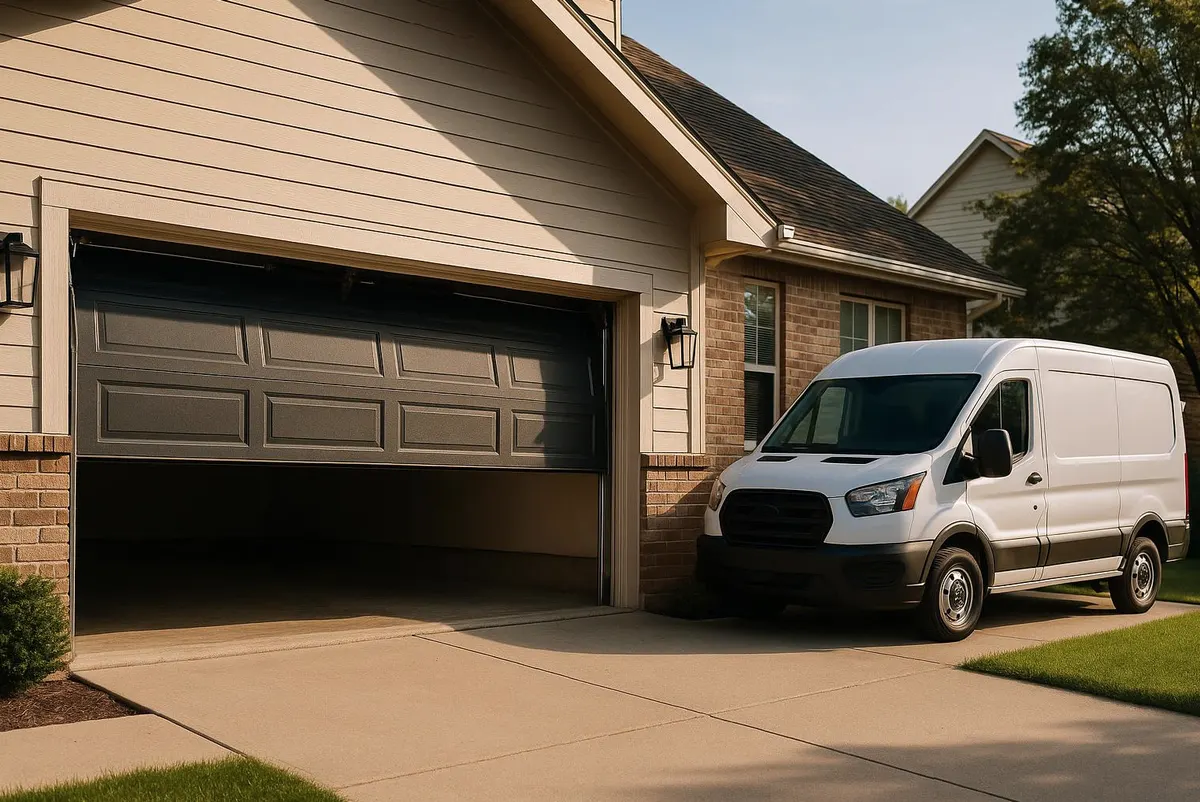
The mistake most people make first is assuming a garage door is a garage door — that a home's single door and a warehouse's rollup door just differ in size. It's a tempting assumption because they look similar: panels, a track, springs, an opener. If you've ever argued with a spouse about whether to put a "heavy-duty commercial" door on the garage-turned-workshop, or whether the maintenance schedule for your house door is overkill (or not enough), this is the argument that settles it.
The Real Differences Aren't Just Size
Commercial and warehouse doors are engineered for a completely different job than a residential garage door, even when they look alike.
- Cycle life: A typical residential door and springs are rated for roughly 10,000 open-close cycles. Commercial-grade springs and hardware are often rated for 20,000 to 100,000+ cycles because a warehouse door might open dozens of times a day, every day.
- Materials and gauge: Commercial doors usually use heavier-gauge steel, reinforced struts, and industrial-grade tracks to handle constant use and, often, larger openings.
- Springs and counterbalance systems: Commercial doors frequently use torsion springs rated for higher cycle counts, and larger doors may need multiple springs or a different counterbalance setup entirely.
- Operators: A residential opener is built for a few cycles a day. A commercial operator is built for continuous duty, higher horsepower, and often safety features suited to employee traffic.
None of this means a commercial door is simply "better." It means it's built for a different workload. Putting a true commercial door on a house, or treating a home door like it can handle commercial-level abuse, usually ends in wasted money or an early breakdown.
Why This Matters More Here Than in Drier, Calmer Climates
Florida's coast adds variables that most of the country doesn't deal with. Salt air accelerates corrosion on hinges, tracks, and spring coils, especially on doors closer to the water. Heat and humidity cause wood and composite panels to swell and warp, and they can dry out lubricant faster than you'd expect. And because this area sits under wind-load rules for garage doors, both residential and commercial doors need hardware and bracing rated for wind pressure, not just whatever came with the cheapest unit.
A detached garage used as a home business, workshop, or storage building often gets opened far more often than a typical house garage. That pushes it closer to commercial-use territory even if the door itself is residential-grade. That's usually the real root of the spousal disagreement: one of you is thinking about how the door is built, the other is thinking about how often it actually gets used.
Maintenance Isn't the Same Either
Because of the cycle difference, commercial doors typically need more frequent professional inspection — often quarterly in heavy-use settings — covering spring tension, cable wear, track alignment, and sensor function. A residential door doing a few cycles a day can usually run on a twice-yearly tune-up schedule.
But in this climate, even a low-use residential door benefits from extra attention around hurricane season: checking that panels haven't swollen or warped, that hinges and rollers aren't seizing from salt and humidity, and that weatherstripping is sealing properly before the next round of afternoon downpours. Skipping maintenance because "it's just a house door" is how small issues — a stiff roller, a slightly rusted hinge — turn into an off-track door or a snapped cable during a storm.
If You're Debating a Door for a Workshop or Side Business
If the space will see frequent daily use, heavier vehicles, or regular employee or customer traffic, lean toward commercial-rated hardware and a more frequent inspection schedule, even if the building looks residential from the outside. If it's genuinely a once-a-day home garage, standard residential equipment with solid seasonal maintenance is the more practical and cost-effective choice.
When to Call Daytona Beach Garage Door Repair
If you're not sure which category your door actually falls into, or you're noticing a door struggling to keep up with how often it's used, that's worth a professional look before springs or cables start to fail. We handle everything from Garage Door Spring Repair for a door under more strain than it was built for, to Garage Door Tune-Up & Maintenance that accounts for salt air, humidity, and wind-load hardware specific to this area. We'll tell you honestly whether you need residential service or something closer to commercial-grade equipment — no upselling, just what the door actually needs.
If you're weighing a workshop upgrade, dealing with a stubborn door, or just want a professional opinion to settle the debate, call Daytona Beach Garage Door Repair today and we'll get it sorted — serving Daytona Beach, Ormond Beach, Port Orange, and the rest of Volusia County.