
Put off a garage door inspection for one more hurricane season and you're not just risking an inconvenient bounce back on a sticky remote. You're risking a 150-pound door coming down on a car, a spring letting go with enough force to dent drywall, or a panel that's been quietly swelling with salt-humid air since last June finally splitting down the seam. A standard home inspection usually gives the garage door about ninety seconds: open it, close it, check the light sensors, move on. That's not enough to catch what actually fails here, where wind-load rules, coastal moisture, and afternoon downpours put more stress on a door than almost anywhere else in the state.
Before you sign off on a home, walk the garage yourself with this list. None of it requires tools you don't already own.
The Walk-Through Checklist
1. Spring type and visible rust
Look up at the horizontal bar above the door (torsion spring) or alongside the tracks (extension springs). Surface rust is cosmetic; rust that's eaten into the coils or left a visible gap between them means the spring is near the end of its life. A failed spring doesn't just stop the door — it can let the door drop suddenly if someone's underneath it.
2. Cable condition at the bottom brackets
Crouch down and look at the cables running to the bottom corners of the door. Frayed strands, kinks, or a cable that looks loose and loopy instead of taut is a sign it's about to snap. A snapped cable under tension is one of the more dangerous garage door failures, and it's an easy thing for a rushed inspection to miss.
3. Track alignment and rust at the rollers
Run your eyes down both tracks. They should be parallel, with no gaps between the rollers and the track wall. Rust streaks on the rollers or flaking paint on the tracks is common in salt-air zones closer to the coast and usually means the hardware has been sitting damp longer than it should. Misaligned tracks are also the number-one cause of doors jumping off track entirely.
4. Panel condition, especially the bottom panel
Press gently on the lowest panel, particularly near the corners. Sponginess, bubbling paint, or a panel that flexes more than the ones above it points to water intrusion and swelling — common in older steel or wood-composite doors that have taken on moisture from ground splash-back during heavy rain. A soft panel today is a panel that needs full replacement within a year or two.
5. Weatherstripping and the bottom seal
Check the rubber strip along the floor and the vinyl seal around the sides. Cracked, flattened, or missing weatherstripping lets water, insects, and wind-driven rain into the garage during storms. It's cheap to replace but frequently ignored because it doesn't affect whether the door opens.
6. Opener age and the safety reversal test
Find the opener's manufacture date on the motor unit label if you can. Openers older than 10–15 years often lack modern safety reversal sensors or have sensors that have drifted out of alignment. Test it: place a 2x4 flat on the ground where the door closes. The door should reverse immediately on contact. If it doesn't, that's not a cosmetic issue — it's a safety failure.
7. Wind-load bracing on the door itself
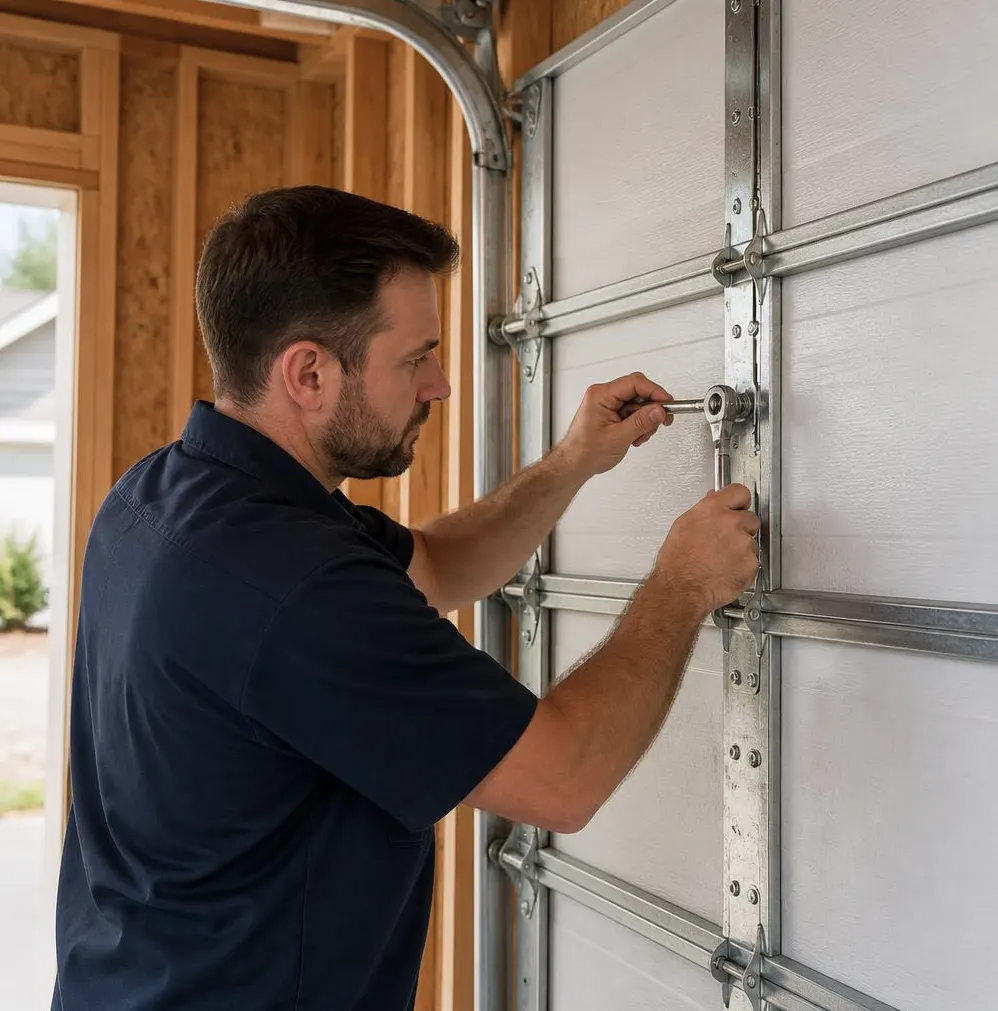
Flip the door over (or look at the back if it's a sectional door) for horizontal reinforcement struts. In hurricane-prone areas, doors without this bracing are more vulnerable to buckling under high wind pressure. If the struts are missing, bent, or rusted through, the door may not perform the way it's rated to in a storm.
8. Hardware tightness — hinges, brackets, fasteners
Give the hinges and track brackets a wiggle test by hand. Loose screws and wallowed-out holes are common after years of door cycling and humidity swings that expand and contract wood framing. Loose hardware is cheap to fix now and expensive to ignore once a bracket pulls free.
9. Manual balance test
Disconnect the opener (pull the red release cord) and lift the door by hand to about waist height, then let go. A properly balanced door stays put. If it drops on its own or shoots upward, the springs are improperly tensioned — a problem that puts extra strain on the opener motor every single time it runs.
What a Failed Item Actually Costs You Later
None of these are reasons to walk away from a house. They're negotiating points and maintenance items. But a rusted spring or an unbraced door that gets ignored through one more hot, humid season — especially one that includes storm activity — tends to fail at the worst possible moment: locked out of the garage during a downpour, or worse, a door that won't hold against wind pressure when it matters.
When to Call Daytona Beach Garage Door Repair
If your walk-through turns up rusted springs, frayed cables, or a door that's off-balance, that's exactly what our Garage Door Spring Repair and Garage Door Tune-Up & Maintenance visits are built for — we'll inspect the full system, replace what's failing, and rebalance the door so it's not putting extra wear on the opener. If the door's jumped track or the panels show real water damage, we handle Off Track Door Repair and panel work too, with same-day service available across Daytona Beach, Daytona Beach Shores, Ormond Beach, Port Orange, and the surrounding area.
Closing on a home soon or just inherited a garage door you're not sure about? Call Daytona Beach Garage Door Repair for a straightforward inspection before the next storm rolls in.